
By Hayden Shumsky | The Shumsky Center for Academic and Career Performance | Houston, TX
You have done everything right. Your son or daughter attends The Kinkaid School — one of the finest independent schools in the country. The facilities are extraordinary, the teachers accomplished, the peers bright and motivated. Your child takes AP courses, plays a varsity sport, rehearses for the school play, and volunteers on weekends. The college counseling office at Kinkaid is well-regarded.

So why are so many Kinkaid families sitting across from me here at the Shumsky Center — anxious, confused, and in some cases deeply worried — in the months and years before their child’s college application is due?
Because attending a great school is not the same thing as having a great plan. And in today’s hyper-competitive college admissions climate, the difference between those two things can determine the shape of a young person’s life.
The Particular Pressures on Kinkaid Families
Kinkaid is not just any private school. It is a school where everyone expects to attend a top college, where AP coursework is the rule rather than the exception, and where the peer culture — for all its warmth and spirit — is relentlessly competitive. The invisible and ruthless competition — for class rank, for AP scores, for a spot in the most selective college freshman classes — runs 365 days a year.
This environment creates a specific and painful set of pressures. We see them play out in our offices regularly. Here are the ones that matter most.
1. The Paradox of Privilege: Too Many Options, Too Little Direction
Kinkaid students have access to extraordinary resources: robust AP and honors course offerings, a college counseling team, awesome internship connections with the Houston business community, and peers who push them academically. These are the valuable attributes that lead parents and students to choose Kinkaid in the first place.
But access to opportunity is not the same as clarity of direction. In our experience, Kinkaid students — especially those in 9th and 10th grade — are often deeply uncertain about who they are as learners, human beings, and what they actually want from their high school and college years. They have been high achievers for so long that the question of what genuinely interests them, apart from what earns the best grade or impresses the most adults, is not necessarily asked of them. Frequently, I meet students who are excellent at school but lack the self-knowledge and coherent story that top college admission committees are looking for.
The painful truth: a student with a 4.2 GPA, three AP courses, and four disjointed extracurricular activities is not more compelling than a student with a 3.8 GPA and one or several deeply-pursued passions or curiosities. College admissions officers at selective schools are not particularly impressed by well-rounded students from top private high schools. Increasingly, they are looking for genuine intellectual identity. Kinkaid students, because they have access to so many activities and opportunities, often inadvertently do a great deal and reveal next to nothing as far as admissions staff are concerned.
2. The College List Problem: Playing It Safe in All the Wrong Ways
I see college lists from Kinkaid students that are mis-aligned in two predictable, yet equally problematic ways.
The first error: anchoring the entire list around U.S. News & World Report rankings. The family targets the top 20 schools regardless of fit, actual academic quality in their prospective major, or the student’s social, academic, and personal profile. The list is built on prestige, not on a rigorous analysis of curriculum, student culture, class size, or career outcomes. Some of these students find themselves devastated in March and April when reach schools say no and safety schools feel like failures. No one ever asked whether the target and safety schools were actually good fits for the student in the first place.
The second error: deciding too early that a student is a ‘Texas school kid’ and failing to seriously research the full national landscape of excellent universities. Excellent schools like Tulane, Wake Forest, University of Rochester, Case Western Reserve, and dozens of others offer outstanding education in specific fields that may be far better suited to your child’s academic and personal profile than a flagship state university where your son or daughter will be one of 50,000 students.
The right college list is not long or short, reach-heavy or safety-heavy. It is customized — built on a thorough understanding of who your student is, their skills, weaknesses, and ambitions, what they need to succeed, and what specific colleges actually offer to fulfill their needs.
3. The GPA Arms Race: What Kinkaid’s Rigor Does and Doesn’t Do for You
Kinkaid’s academic program is genuinely rigorous. Students work hard and grades are not inflated with winks and handshakes. An A grade in an AP or Honors course at Kinkaid represents real achievement.
And yet: selective colleges do not simply rank students by GPA. They evaluate a student’s transcript in the context of their school’s grading practices, course availability, and academic culture. A 3.7 GPA at Kinkaid may be more impressive than a 4.0 at many other schools, -though not every admissions department knows the details of Kinkaid’s rigorous curriculum- but only if the student’s application clearly conveys the intellectual engagement behind the grades.
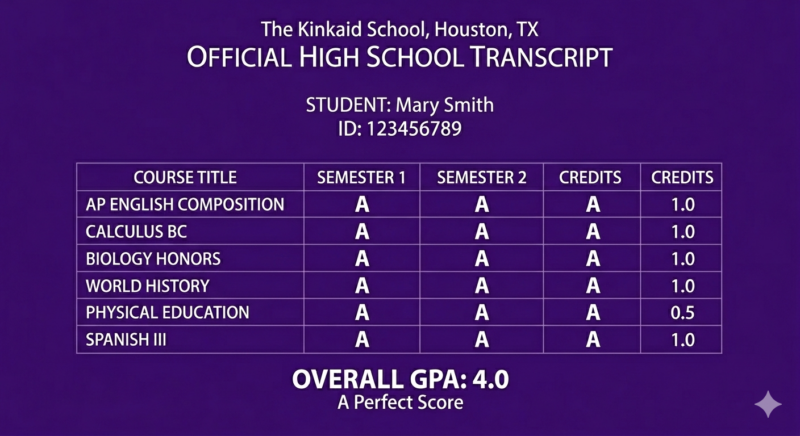
I see a tendency among Kinkaid students, like their peers at other top schools, to over-invest in GPA management. They sometimes drop a challenging course to protect a class rank, choose the ‘safer’ AP over the one they are genuinely curious about, or spend the summer on test prep rather than a substantive experience that would have made for a compelling essay. These choices feel rational in the moment yet cost the student dearly in the long run.
4. The Test Score Trap
Kinkaid students typically obtain outstanding test scores. The school’s average SAT and ACT scores are significantly above national norms. This is good news. There is however, a hidden downside: families overestimate the value of a very high test score and underestimate everything else.
A score of 1540 on the SAT does not make up for an unfocused extracurricular profile. A 35 ACT does not compensate for essays that are generic, safe, and ultimately forgettable. And in a testing landscape where a growing number of selective schools have moved to test-optional or test-flexible policies, the assumption that your child’s score is their primary competitive advantage is an increasingly dangerous one.
Test scores are most often a threshold, not a differentiator. Once you are in the ballpark for a given school, the score matters less than virtually everything else on the application.
5. The Essay: Where Kinkaid Students Most Consistently Fall Short
Kinkaid School teaches their students to be excellent writers. Students are trained to construct arguments, analyze texts, and write with clarity and precision. These are real skills.
But the college essay is not a school assignment, and strong academic writing is not the same thing as a strong personal essay. The college essay requires a student to reveal something authentic and specific about who they are — not as a student, but as a human being. It requires vulnerability, specificity, and a willingness to be genuinely personal in a way that most high-achieving students have never been asked to do. While some of my Kinkaid clients produce fantastic application essays without prompting from me, most of the time, they do not have a clue about how to write the kind of detailed, honest, and personal essays expected by top colleges.

The Kinkaid applicant who writes about the lessons learned from their team’s championship loss, their passion for community service, or ‘how my family taught me to persevere’ is writing an essay that reads like ten thousand other essays from ten thousand other high-achieving students at private schools across the country. Admissions officers at Harvard, Duke, and Vanderbilt have read that essay. It does not work.
The student who writes with precision and genuine self-knowledge about a specific, even ordinary moment that reveals an unexpected dimension of their character — that student stands out. Finding that essay requires work, time, and honest self-examination. It rarely happens without guidance.
6. The Career and Major Confusion: What Am I Actually Going to Do?
The Kinkaid community and administration have invested heavily in modernizing the school’s curriculum, facilities, and academic offerings. Their programs and resources are among the best one can find in the United States. The school provides genuine exposure to a wide range of disciplines and incredible opportunities for exploration and growth. And yet: when a tenth or eleventh grader from Kinkaid sits down with me for the first time, and I ask what they want to study and what kind of life they want to build, the answer is almost always some version of ‘I don’t know.’
This is not a failure of the student. I would even go so far as to say it is not for a shortage of chances to learn from the awesome people at Kinkaid. It is a failure of the planning process.
Choosing a major and a prospective career path is not simply a question of what a student is good at or what their parents do for a living. It requires a serious investigation of the student’s intellectual curiosities, their working style, their tolerance for stress and ambiguity, their financial goals, and their vision of a meaningful life. It requires understanding what specific academic departments at specific colleges actually offer — not just the name of the major, but the courses, the professors, the research opportunities, and the career pipelines.

A Kinkaid student who declares ‘pre-med’ because it is the family expectation and then discovers in the second semester of organic chemistry that they hate laboratory work has not been well-served by anyone in their planning process. A student who chooses economics because ‘it leads to good jobs’ and then spends four years doing something they find meaningless suffers from the same disease. These outcomes are preventable, but they honest, early, and sustained advising.
What Kinkaid Families Must Do Differently
The families who navigate this process successfully — whose children end up at schools that are genuinely right for them and then thrive once they get there — share a few things in common.
They start early. Not in November of junior year, but in ninth or tenth grade, when there is plenty of time to make meaningful course choices, develop genuine extracurricular depth, and begin the process of self-examination that good college planning requires.
These families throw out the rankings. Not because rankings are always useless, but because a ranking tells you nothing about whether a particular college is right for your particular child. The only way to know that is to do the work: research academic departments, read syllabi, talk to current students, and evaluate specific programs against a thorough understanding of the student and what they need.
They also invest in honest self-assessment. Not the kind that produces a polished personal brand, but the kind that asks hard questions. What does my child genuinely love? What are their real weaknesses — not the ‘I work too hard’ weakness they will give an interviewer, but the actual academic and personal challenges they face? What kind of social environment will help them flourish? What do they need to feel supported? These questions matter more than any single metric on a college application.
And they get independent guidance. Not because the Kinkaid college counseling office is inadequate — it is not — but because independent advisors work exclusively for the student and family, with unlimited time and without the institutional constraints that any school counselor must operate within. A great independent advisor helps your child understand those things that could be uncomfortable to hear, makes a plan that is genuinely customized to your child, and stays with you through every step of a process that is complex and more consequential than most families realize.
We Have Been Doing This Work in Houston Since 1987
The Shumsky Center has guided Kinkaid families — and students from St. John’s, Strake Jesuit, The Awty International School, Second Baptist, Episcopal High School, and many other Houston private schools — through the college planning process for nearly four decades. Many of those students thought that they had everything figured out and discovered, through careful conversation with a trusted advisor, that their original plans were full of fantasy, hearsay, and naive assumptions. Together, we transformed their direction and built a plan that was informed and truly authentic.
I have also worked with Kinkaid students who were struggling — academically, emotionally, or both — and helped them find colleges and programs where they could succeed on their own terms. I do not believe in a single model of success. I believe in honest and compassionate assessment, careful planning, and advising that includes the full complexity of a student’s life.
If your son or daughter is at Kinkaid and you are beginning to feel the pressure of the college planning process — or if you have been feeling it for a while and are not sure whether your current plan is working — I would welcome the conversation.
The Shumsky Center for Academic and Career Performance
4299 San Felipe, Suite 210 | Houston, Texas 77027
713.784.6610 | info@shumskycenter.com | shumskycenter.com
College Admissions Consulting | Career Advising | Learning & Attention Disorders | Residential Placement