The Kinkaid Student’s Hidden College Planning Crisis: What Houston’s Most Competitive Families Get Wrong

By Hayden Shumsky | The Shumsky Center for Academic and Career Performance | Houston, TX

You have done everything right. Your son or daughter attends The Kinkaid School — one of the finest independent schools in the country. The facilities are extraordinary, the teachers accomplished, the peers bright and motivated. Your child takes AP courses, plays a varsity sport, rehearses for the school play, and volunteers on weekends. The college counseling office at Kinkaid is well-regarded.
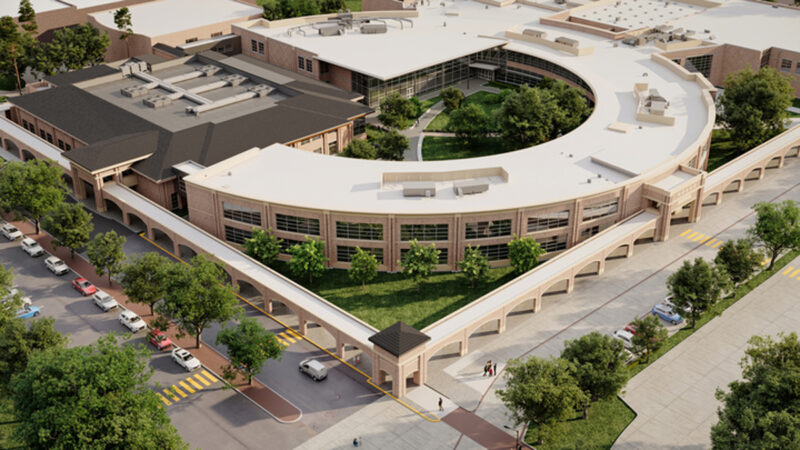
Kinkaid Upper School, Houston, Texas. Rendering from allin.kinkaid.org

So why are so many Kinkaid families sitting across from me here at the Shumsky Center — anxious, confused, and in some cases deeply worried — in the months and years before their child’s college application is due?

Because attending a great school is not the same thing as having a great plan. And in today’s hyper-competitive college admissions climate, the difference between those two things can determine the shape of a young person’s life.

The Particular Pressures on Kinkaid Families

Kinkaid is not just any private school. It is a school where everyone expects to attend a top college, where AP coursework is the rule rather than the exception, and where the peer culture — for all its warmth and spirit — is relentlessly competitive. The invisible and ruthless competition — for class rank, for AP scores, for a spot in the most selective college freshman classes — runs 365 days a year.

This environment creates a specific and painful set of pressures. We see them play out in our offices regularly. Here are the ones that matter most.

1. The Paradox of Privilege: Too Many Options, Too Little Direction

Kinkaid students have access to extraordinary resources: robust AP and honors course offerings, a college counseling team, awesome internship connections with the Houston business community, and peers who push them academically. These are the valuable attributes that lead parents and students to choose Kinkaid in the first place.
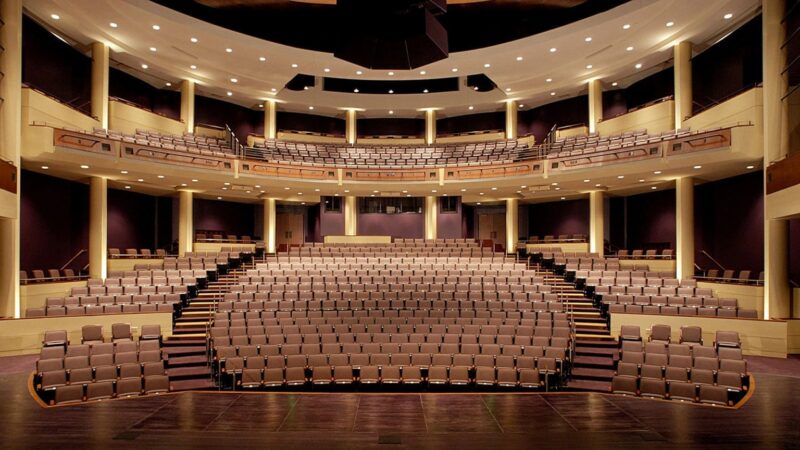
Kinkaid School, Houston, Texas, Katz Arts Center

But access to opportunity is not the same as clarity of direction. In our experience, Kinkaid students — especially those in 9th and 10th grade — are often deeply uncertain about who they are as learners, human beings, and what they actually want from their high school and college years. They have been high achievers for so long that the question of what genuinely interests them, apart from what earns the best grade or impresses the most adults, is not necessarily asked of them. Frequently, I meet students who are excellent at school but lack the self-knowledge and coherent story that top college admission committees are looking for.

The painful truth: a student with a 4.2 GPA, three AP courses, and four disjointed extracurricular activities is not more compelling than a student with a 3.8 GPA and one or several deeply-pursued passions or curiosities. College admissions officers at selective schools are not particularly impressed by well-rounded students from top private high schools. Increasingly, they are looking for genuine intellectual identity. Kinkaid students, because they have access to so many activities and opportunities, often inadvertently do a great deal and reveal next to nothing as far as admissions staff are concerned.

2. The College List Problem: Playing It Safe in All the Wrong Ways

I see college lists from Kinkaid students that are mis-aligned in two predictable, yet equally problematic ways.
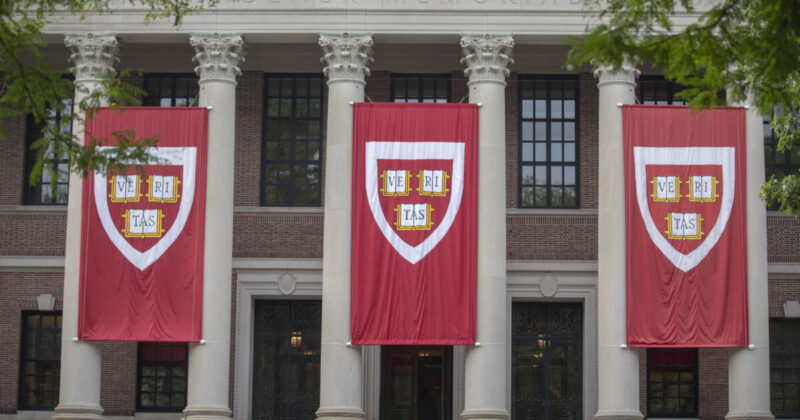
Harvard Veritas, Harvard University, Cambridge, Massachusetts
Kris Snibbe/Harvard Staff Photographer

The first error: anchoring the entire list around U.S. News & World Report rankings. The family targets the top 20 schools regardless of fit, actual academic quality in their prospective major, or the student’s social, academic, and personal profile. The list is built on prestige, not on a rigorous analysis of curriculum, student culture, class size, or career outcomes. Some of these students find themselves devastated in March and April when reach schools say no and safety schools feel like failures. No one ever asked whether the target and safety schools were actually good fits for the student in the first place.

The second error: deciding too early that a student is a ‘Texas school kid’ and failing to seriously research the full national landscape of excellent universities. Excellent schools like Tulane, Wake Forest, University of Rochester, Case Western Reserve, and dozens of others offer outstanding education in specific fields that may be far better suited to your child’s academic and personal profile than a flagship state university where your son or daughter will be one of 50,000 students.

The right college list is not long or short, reach-heavy or safety-heavy. It is customized — built on a thorough understanding of who your student is, their skills, weaknesses, and ambitions, what they need to succeed, and what specific colleges actually offer to fulfill their needs.

3. The GPA Arms Race: What Kinkaid’s Rigor Does and Doesn’t Do for You

Kinkaid’s academic program is genuinely rigorous. Students work hard and grades are not inflated with winks and handshakes. An A grade in an AP or Honors course at Kinkaid represents real achievement.

And yet: selective colleges do not simply rank students by GPA. They evaluate a student’s transcript in the context of their school’s grading practices, course availability, and academic culture. A 3.7 GPA at Kinkaid may be more impressive than a 4.0 at many other schools, -though not every admissions department knows the details of Kinkaid’s rigorous curriculum- but only if the student’s application clearly conveys the intellectual engagement behind the grades.
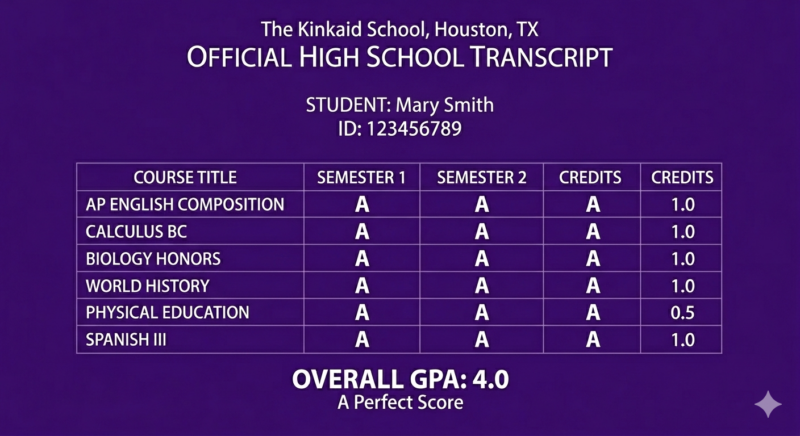
Kinkaid School, Perfect Student, 4.0GPA on high school transcript, Houston, Texas

I see a tendency among Kinkaid students, like their peers at other top schools, to over-invest in GPA management. They sometimes drop a challenging course to protect a class rank, choose the ‘safer’ AP over the one they are genuinely curious about, or spend the summer on test prep rather than a substantive experience that would have made for a compelling essay. These choices feel rational in the moment yet cost the student dearly in the long run.

4. The Test Score Trap

Kinkaid students typically obtain outstanding test scores. The school’s average SAT and ACT scores are significantly above national norms. This is good news. There is however, a hidden downside: families overestimate the value of a very high test score and underestimate everything else.

A score of 1540 on the SAT does not make up for an unfocused extracurricular profile. A 35 ACT does not compensate for essays that are generic, safe, and ultimately forgettable. And in a testing landscape where a growing number of selective schools have moved to test-optional or test-flexible policies, the assumption that your child’s score is their primary competitive advantage is an increasingly dangerous one.

Test scores are most often a threshold, not a differentiator. Once you are in the ballpark for a given school, the score matters less than virtually everything else on the application.

5. The Essay: Where Kinkaid Students Most Consistently Fall Short

Kinkaid School teaches their students to be excellent writers. Students are trained to construct arguments, analyze texts, and write with clarity and precision. These are real skills.

But the college essay is not a school assignment, and strong academic writing is not the same thing as a strong personal essay. The college essay requires a student to reveal something authentic and specific about who they are — not as a student, but as a human being. It requires vulnerability, specificity, and a willingness to be genuinely personal in a way that most high-achieving students have never been asked to do. While some of my Kinkaid clients produce fantastic application essays without prompting from me, most of the time, they do not have a clue about how to write the kind of detailed, honest, and personal essays expected by top colleges.

College Essay, Kinkaid School, Houston, Texas

The Kinkaid applicant who writes about the lessons learned from their team’s championship loss, their passion for community service, or ‘how my family taught me to persevere’ is writing an essay that reads like ten thousand other essays from ten thousand other high-achieving students at private schools across the country. Admissions officers at Harvard, Duke, and Vanderbilt have read that essay. It does not work.

The student who writes with precision and genuine self-knowledge about a specific, even ordinary moment that reveals an unexpected dimension of their character — that student stands out. Finding that essay requires work, time, and honest self-examination. It rarely happens without guidance.

6. The Career and Major Confusion: What Am I Actually Going to Do?

The Kinkaid community and administration have invested heavily in modernizing the school’s curriculum, facilities, and academic offerings. Their programs and resources are among the best one can find in the United States. The school provides genuine exposure to a wide range of disciplines and incredible opportunities for exploration and growth. And yet: when a tenth or eleventh grader from Kinkaid sits down with me for the first time, and I ask what they want to study and what kind of life they want to build, the answer is almost always some version of ‘I don’t know.’

This is not a failure of the student. I would even go so far as to say it is not for a shortage of chances to learn from the awesome people at Kinkaid. It is a failure of the planning process.

Choosing a major and a prospective career path is not simply a question of what a student is good at or what their parents do for a living. It requires a serious investigation of the student’s intellectual curiosities, their working style, their tolerance for stress and ambiguity, their financial goals, and their vision of a meaningful life. It requires understanding what specific academic departments at specific colleges actually offer — not just the name of the major, but the courses, the professors, the research opportunities, and the career pipelines.

Pre-Med Majors, Kinkaid School, Houston, Texas

A Kinkaid student who declares ‘pre-med’ because it is the family expectation and then discovers in the second semester of organic chemistry that they hate laboratory work has not been well-served by anyone in their planning process. A student who chooses economics because ‘it leads to good jobs’ and then spends four years doing something they find meaningless suffers from the same disease. These outcomes are preventable, but they honest, early, and sustained advising.

What Kinkaid Families Must Do Differently

The families who navigate this process successfully — whose children end up at schools that are genuinely right for them and then thrive once they get there — share a few things in common.

They start early. Not in November of junior year, but in ninth or tenth grade, when there is plenty of time to make meaningful course choices, develop genuine extracurricular depth, and begin the process of self-examination that good college planning requires.

These families throw out the rankings. Not because rankings are always useless, but because a ranking tells you nothing about whether a particular college is right for your particular child. The only way to know that is to do the work: research academic departments, read syllabi, talk to current students, and evaluate specific programs against a thorough understanding of the student and what they need.

They also invest in honest self-assessment. Not the kind that produces a polished personal brand, but the kind that asks hard questions. What does my child genuinely love? What are their real weaknesses — not the ‘I work too hard’ weakness they will give an interviewer, but the actual academic and personal challenges they face? What kind of social environment will help them flourish? What do they need to feel supported? These questions matter more than any single metric on a college application.

And they get independent guidance. Not because the Kinkaid college counseling office is inadequate — it is not — but because independent advisors work exclusively for the student and family, with unlimited time and without the institutional constraints that any school counselor must operate within. A great independent advisor helps your child understand those things that could be uncomfortable to hear, makes a plan that is genuinely customized to your child, and stays with you through every step of a process that is complex and more consequential than most families realize.

We Have Been Doing This Work in Houston Since 1987

The Shumsky Center has guided Kinkaid families — and students from St. John’s, Strake Jesuit, The Awty International School, Second Baptist, Episcopal High School, and many other Houston private schools — through the college planning process for nearly four decades. Many of those students thought that they had everything figured out and discovered, through careful conversation with a trusted advisor, that their original plans were full of fantasy, hearsay, and naive assumptions. Together, we transformed their direction and built a plan that was informed and truly authentic.

I have also worked with Kinkaid students who were struggling — academically, emotionally, or both — and helped them find colleges and programs where they could succeed on their own terms. I do not believe in a single model of success. I believe in honest and compassionate assessment, careful planning, and advising that includes the full complexity of a student’s life.

If your son or daughter is at Kinkaid and you are beginning to feel the pressure of the college planning process — or if you have been feeling it for a while and are not sure whether your current plan is working — I would welcome the conversation.

The Shumsky Center for Academic and Career Performance

4299 San Felipe, Suite 210  |  Houston, Texas 77027

713.784.6610  |  info@shumskycenter.com  |  shumskycenter.com

College Admissions Consulting  |  Career Advising  |  Learning & Attention Disorders  |  Residential Placement

Important Information Update: A Searchable Database of 100 Top Public Research Universities and Their Fall 2020 Coronavirus (Covid-19) Plans

Coronavirus (Covid-19) has impacted university's plans and teaching methods for Fall 2020.

Davidson College and The Washington Post have created a database with updated information on top public universities and their teaching method and plans for accommodating Covid-19 during the Fall 2020 semester. Information includes start date and the university’s Fall 2020 teaching method (in-person, online, hybrid) .

SchoolStateTeaching methodFall start
Auburn U.Ala.HybridAug. 17
U. of AlabamaAla.Primarily in personAug. 19
U. of Alaska at AnchorageAlaskaPrimarily onlineAug. 24
U. of Alaska at FairbanksAlaskaHybridAug. 24
Arizona State U. at TempeAriz.HybridAug. 20
U. of ArizonaAriz.Primarily onlineAug. 24
Arkansas State U.Ark.Primarily in personAug. 25
U. of ArkansasArk.Primarily onlineAug. 24
U. of California at BerkeleyCalif.Primarily onlineAug. 26
UCLACalif.Primarily onlineSept. 28
U. of Colorado at BoulderColo.Primarily onlineAug. 24
Colorado School of MinesColo.Primarily in personAug. 24
Central Connecticut State U.Conn.Primarily onlineAug. 26
U. of ConnecticutConn.Primarily onlineAug. 31
Delaware State U.Del.HybridAug. 25
U. of DelawareDel.Primarily onlineSept. 1
U. of the District of ColumbiaD.C.Primarily onlineSept. 8
Florida State U.Fla.HybridAug. 24
U. of FloridaFla.Primarily onlineAug. 31
Georgia Inst. of TechnologyGa.Primarily in personAug. 17
U. of GeorgiaGa.Primarily in personAug. 20
U. of Hawaii at HiloHawaiiPrimarily onlineAug. 24
U. of Hawaii at ManoaHawaiiPrimarily onlineAug. 24
Idaho State U.IdahoPrimarily in personAug. 17
U. of IdahoIdahoPrimarily in personAug. 31
U. of Illinois at ChicagoIll.Primarily onlineAug. 26
U. of Illinois at Urbana-ChampaignIll.HybridAug. 24
Indiana University at BloomingtonInd.Primarily onlineAug. 24
Purdue U.Ind.Primarily in personAug. 24
Iowa State U.IowaPrimarily in personAug. 17
U. of IowaIowaPrimarily in personAug. 24
Kansas State U.Kan.Primarily in personAug. 17
U. of KansasKan.Primarily in personAug. 24
U. of KentuckyKy.Primarily onlineAug. 17
U. of LouisvilleKy.Primarily onlineAug. 17
Louisiana State U.La.Primarily onlineAug. 24
Louisiana Tech U.La.Primarily in personAug. 31
U. of Maine at FarmingtonMaineHybridAug. 31
U. of Maine at OronoMaineTo be determinedAug. 31
U. of Maryland Baltimore CountyMd.Primarily onlineAug. 27
U. of Maryland at College ParkMd.Primarily onlineAug. 31
U. of Massachusetts at AmherstMass.Primarily onlineAug. 24
U. of Massachusetts at LowellMass.Primarily onlineSept. 1
Michigan State U.Mich.Fully onlineSept. 2
U. of Michigan at Ann ArborMich.HybridAug. 31
U. of Minnesota at DuluthMinn.HybridAug. 31
U. of Minnesota at Twin CitiesMinn.HybridAug. 31
Mississippi State U.Miss.HybridAug. 17
U. of MississippiMiss.HybridAug. 24
Missouri U. of Science and Tech.Mo.Primarily in personAug. 24
U. of MissouriMo.Primarily onlineAug. 24
Montana State U.Mont.Primarily onlineAug. 17
U. of MontanaMont.Primarily onlineAug. 19
U. of Nebraska at LincolnNeb.Primarily in personAug. 17
U. of Nebraska at OmahaNeb.Primarily in personAug. 24
U. of Nevada at Las VegasNev.Primarily onlineAug. 24
U. of Nevada at RenoNev.Primarily in personAug. 24
Plymouth State U.N.H.HybridAug. 24
U. of New HampshireN.H.Primarily onlineAug. 31
Rutgers U. at New BrunswickN.J.Primarily onlineSept. 1
Rutgers U. at NewarkN.J.Primarily onlineSept. 3
New Mexico State U.N.M.HybridAug. 19
U. of New MexicoN.M.HybridAug. 17
Stony Brook U.N.Y.Primarily onlineAug. 24
U. at BuffaloN.Y.HybridAug. 31
North Carolina State U.N.C.Fully onlineAug. 10
U. of North Carolina at Chapel HillN.C.Fully onlineAug. 10
North Dakota State U.N.D.HybridAug. 24
U. of North DakotaN.D.To be determinedAug. 24
Miami U. of OhioOhioPrimarily onlineAug. 17
Ohio State U.OhioHybridAug. 25
Oklahoma State U.Okla.Primarily in personAug. 17
U. of OklahomaOkla.Primarily in personAug. 24
Oregon State U.Ore.Primarily onlineSept. 23
U. of OregonOre.Primarily onlineSept. 29
Pennsylvania State U.Pa.HybridAug. 24
U. of PittsburghPa.Primarily onlineAug. 19
Rhode Island CollegeR.I.Primarily onlineAug. 31
U. of Rhode IslandR.I.Primarily in personSept. 9
Clemson U.S.C.Primarily onlineAug. 19
U. of South CarolinaS.C.Primarily in personAug. 20
South Dakota State U.S.D.HybridAug. 19
U. of South DakotaS.D.Primarily in personAug. 19
U. of MemphisTenn.Primarily in personAug. 17
U. of TennesseeTenn.HybridAug. 19
Texas A&M U.Tex.Primarily in personAug. 19
U. of Texas at AustinTex.Primarily onlineAug. 26
U. of UtahUtahPrimarily onlineAug. 24
Utah State U.UtahHybridAug. 31
Castleton U.Vt.Fully onlineAug. 18
U. of VermontVt.Primarily in personAug. 31
College of William & MaryVa.Primarily onlineAug. 19
U. of VirginiaVa.Primarily onlineAug. 25
U. of WashingtonWash.Primarily onlineSept. 30
Washington State U.Wash.Primarily onlineAug. 24
Marshall U.W.Va.Primarily in personAug. 24
West Virginia U.W.Va.Primarily onlineAug. 26
U. of Wisconsin at MadisonWis.Primarily onlineSept. 2
U. of Wisconsin at MilwaukeeWis.HybridSept. 2
U. of WyomingWyo.Primarily onlineAug. 24

Critical Updates From Colleges Re: Plans for Fall 2020

Many universities are checking in to give guidance to students and families regarding plans for on-campus instruction in the fall of 2020. Because of the Covid-19 Coronavirus outbreak, nearly all American colleges and universities are currently delivering academics via virtual classes. Almost 99% of current American college students have returned to their homes and college campuses are mostly empty.

Of those who have reported, the majority have indicated that they are committed to delivering on-campus face-to-face instruction in the fall or have not yet committed, but are planning to do so. Top-choice universities like Harvard, the Claremont Colleges, Haveford, and the University of Illinois at Urbana-Champaign have announced that they are committed to holding classes in person this fall. Among Texas colleges and universities, no commitments have been communicated as of yet (April 28, 2020). The University of Texas at Austin is expecting to announce fall 2020 plans at the end of June.

Be sure to watch this page for more updates as decisions are made. For selected universities, current status is available here.

A Contrarian View on Studying Computer Science or Programming from Gary Vaynerchuck

Do you think that a computer science degree is a ticket to future financial and career security? You might want to watch the video below from @garyvee to hear some reasons why your thinking may be incorrect. This video contains salty language, you have been forewarned.

Gary explains that the high level of historical financial returns for computer science majors flows from the shortage of capable computer programmers in a past era. Now that record numbers of students are majoring in computer science worldwide, the financial returns to computer science will drop. The scarcity is gone and the supply of computer scientists and programmers is greater than the demand. Looking forward, Gary suggests that unless your focus is on a cutting edge area of technology with room for exponential growth, like 3D or virtual reality, today’s computer science students will be disappointed by their salaries in the long-term. Gary believes that programming and computer science skills have been commodified and will drop in value going forward.

Do we at Shumsky Center agree? I think Gary brings a perspective that is absent from the minds of many parents and students. There are very few golden tickets that guarantee financial success and career stability. For the last several decades, computer science majors have earned very good salaries in the U.S. For example, estimates from Michigan State University’s Collegiate Employment Research Institute survey of the college class of 2017 show computer science majors with an average starting salary of around $58,000. Top earning graduates with computer science degrees from the college class of 2017 earned as much as $130,000. The National Association of Colleges and Employers’ (NACE) Winter 2017 Salary Survey showed even better results for recent computer science graduates. NACE’s survey showed recent college graduates with computer science degrees earn an average starting salary of $65,500. Looking forward, there is reason to expect the financial return to drop as the field is flooded by new entrants. What are your thoughts?

How to Use 11th Grade Wisely and Get In To Your Dream School


  1. Best Grades Ever: Every kid in America will hear from Mom and Dad about the need to do well in 11th Take it from me, you need to come ready to play every day. Push your grades in 11th grade to the best they’ve ever been.  That’s what admissions folks at top 150 colleges expect. If you need help, ask teachers for tutorials before or after school.  Get a tutor if you’re in danger of a C grade or lower.
  2.  

  3. Take Tough Courses, Especially in Areas of Interest: You do not need to take the entire AP curriculum, but you would be wise to challenge yourself with a tough, but not overwhelming set of courses.  Interested in STEM? Take that AP Physics or Calc offering.  Future social scientist? Push yourself with AP English and AP US History. Love Languages? Spanish IV, Chinese Honors, or IB French is a must.
  4.  

  5. Distinguish Yourself: Break from the pack of tens of thousands of applicants that all have good grades, SAT scores, and overstuffed resumes. Get started on a passion project now.  Write that independent study paper on the performance of small cap stocks in the 2008-2018 period.  Apply to be a research assistant at the local university Bio lab.  Plan a service trip to Tanzania with your classmates. Write and record the solo album for sax. Do what you love!
  6.  

  7. Take Time for Quiet Reflection on What’s Important to You: You’re going to be busy with school, activities, and SAT/ACTs. Mom, Dad, classmates, and school folks will keep the pressure up. But, you must remember that mental health is critical to your success.  Take some time to unwind, let down, and to appreciate what you have.  Think for a few minutes about your future plans and your dream career.  It’s your life, what do you want in it?!
  8.  

  9. Prep for SAT/ACT/Subject Tests: You want to be done with standardized testing by June of 11th You probably need to take the standardized tests at least twice to hit your target score. Be cautious and plan that you’ll need three attempts to reach your desired score.  So, you probably need to take your first test this winter and will want to start prepping by mid-October.
  10.  

  11. Plan Your Summer Now: Summer before 12th grade should be used productively towards your interests.  What would you like to spend 100 hours on this summer? A college course? Soccer skills? Travel, service, research? Don’t wait until spring; start planning now before the school year gets too crazy.

Good College Essays Help Get You In. Here Are The Essay Topics For Fall 2018 College Applications

Essays are a critical element of the college application. If your son or daughter doesn’t catch the eye of admissions readers with an interesting essay, then their chance of acceptance plummets. Want to know the essay topics for 2018-2019 applications?  Look below.

All Topics Are Preliminary and Subject to Change

National Common App Topic Choices

The essay length will continue to be capped at 650 words.

2018-2019 Common Application Essay Prompts

  1. Some students have a background, identity, interest, or talent that is so meaningful they believe their application would be incomplete without it. If this sounds like you, then please share your story.
  2. The lessons we take from obstacles we encounter can be fundamental to later success. Recount a time when you faced a challenge, setback, or failure. How did it affect you, and what did you learn from the experience?
  3. Reflect on a time when you questioned or challenged a belief or idea. What prompted your thinking? What was the outcome?
  4. Describe a problem you’ve solved or a problem you’d like to solve. It can be an intellectual challenge, a research query, an ethical dilemma – anything that is of personal importance, no matter the scale. Explain its significance to you and what steps you took or could be taken to identify a solution.
  5. Discuss an accomplishment, event, or realization that sparked a period of personal growth and a new understanding of yourself or others.
  6. Describe a topic, idea, or concept you find so engaging that it makes you lose all track of time. Why does it captivate you? What or who do you turn to when you want to learn more?
  7. Share an essay on any topic of your choice. It can be one you’ve already written, one that responds to a different prompt, or one of your own design.


UT-Austin Uses Apply Texas application with these requirements:

Required Essay Topic (for all applicants)

Essay Topic A

What was the environment in which you were raised? Describe your family, home, neighborhood, or community, and explain how it has shaped you as a person.

 
Short Answers (250 – 300 words each, all required)

  • If you could have any career, what would it be? Why? Describe any activities you are involved in, life experiences you’ve had, or even classes you’ve taken that have helped you identify this professional path.
  • Do you believe your academic record (transcript information and test scores) provide an accurate representation of you as a student? Why or why not?
  • How do you show leadership in your life? How do you see yourself being a leader at UT Austin?

Art and Art History Majors Must Also Submit this Short Answer Question:

Personal interaction with objects, images and spaces can be so powerful as to change the way one thinks about particular issues or topics. For your intended area of study (art history, design, studio art, visual art studies/art education), describe an experience where instruction in that area or your personal interaction with an object, image or space effected this type of change in your thinking. What did you do to act upon your new thinking and what have you done to prepare yourself for further study in this area?


Texas A&M Uses Apply Texas Application With These Requirements:

Essay A (Required)

What was the environment in which you were raised? Describe your family, home, neighborhood, or community, and explain how it has shaped you as a person.

Applicants to the College of Engineering Only!! Describe your academic and career goals in the broad field of engineering. What and/or who has influenced you either inside or outside the classroom that contributed to these goals?


University of California System Application (UCLA, UC-Berkeley, UC-San Diego, UC-Santa Barbara, etc.)

Instead of a personal statement essay, applicants will be asked to complete “personal insight questions.” Freshman applicants must respond to four of the eight questions, with each response at 350 words or less.

  • Describe an example of your leadership experience in which you have positively influenced others, helped resolve disputes, or contributed to group efforts over time.
  • Every person has a creative side, and it can be expressed in many ways: problem solving, original and innovative thinking, and artistically, to name a few. Describe how you express your creative side.
  • What would you say is your greatest talent or skill? How have you developed and demonstrated that talent over time?
  • Describe how you have taken advantage of a significant educational opportunity or worked to overcome an educational barrier you have faced.
  • Describe the most significant challenge you have faced and the steps you have taken to overcome this challenge. How has this challenge affected your academic achievement?
  • Describe your favorite academic subject and explain how it has influenced you.
  • What have you done to make your school or your community a better place?
  • What is the one thing that you think sets you apart from other candidates applying to the University of California?

College Application Season Begins June 1st


Is your child ready for application season?

11th grade closes soon and college application season looms on the near horizon.  Your family will be making extremely important decisions over the next year and the best decisions are made when families are well-prepared.  Please do not join the ranks of stressed, rushed, and misguided families and students who create hasty college applications and are thus disappointed at college acceptance time.  Ask your son or daughter about the following and make an honest judgment about his or her college plans.  Is he or she prepared and on-schedule?

Has your son or daughter completed the following?

• Identified the final list of 6-10 colleges to apply to, with a minimum of two schools where the student is very likely to be admitted and two more where the student is in the median of who was accepted last year?
• Acquired the target score on the SAT or ACT?
• Received acknowledgments from a minimum of two teachers from core academic subjects regarding recommendation letters?
• Completed a final resume draft?
• Clarified the topics of main application essays which summarize the student’s key traits, experiences, and perspectives and catch the eye of admissions staff?
• Established Plans A, B, and C for prospective college majors and study paths?
• Planned summer activities which will stand out on the student’s application and increase the student’s chances of acceptance?
• Made visits and interview appointments with all colleges he or she will apply to?

If your child has not completed the above steps, then your child is not ready and needs immediate assistance.